When numbers truly tell
how the company works

Accounting

When numbers truly tell
how the company works
Every transport service generates economic data: costs, revenues, public contributions, investments.
Turning this data into reliable, readable and timely information is what allows a company to manage the present and plan for the future.
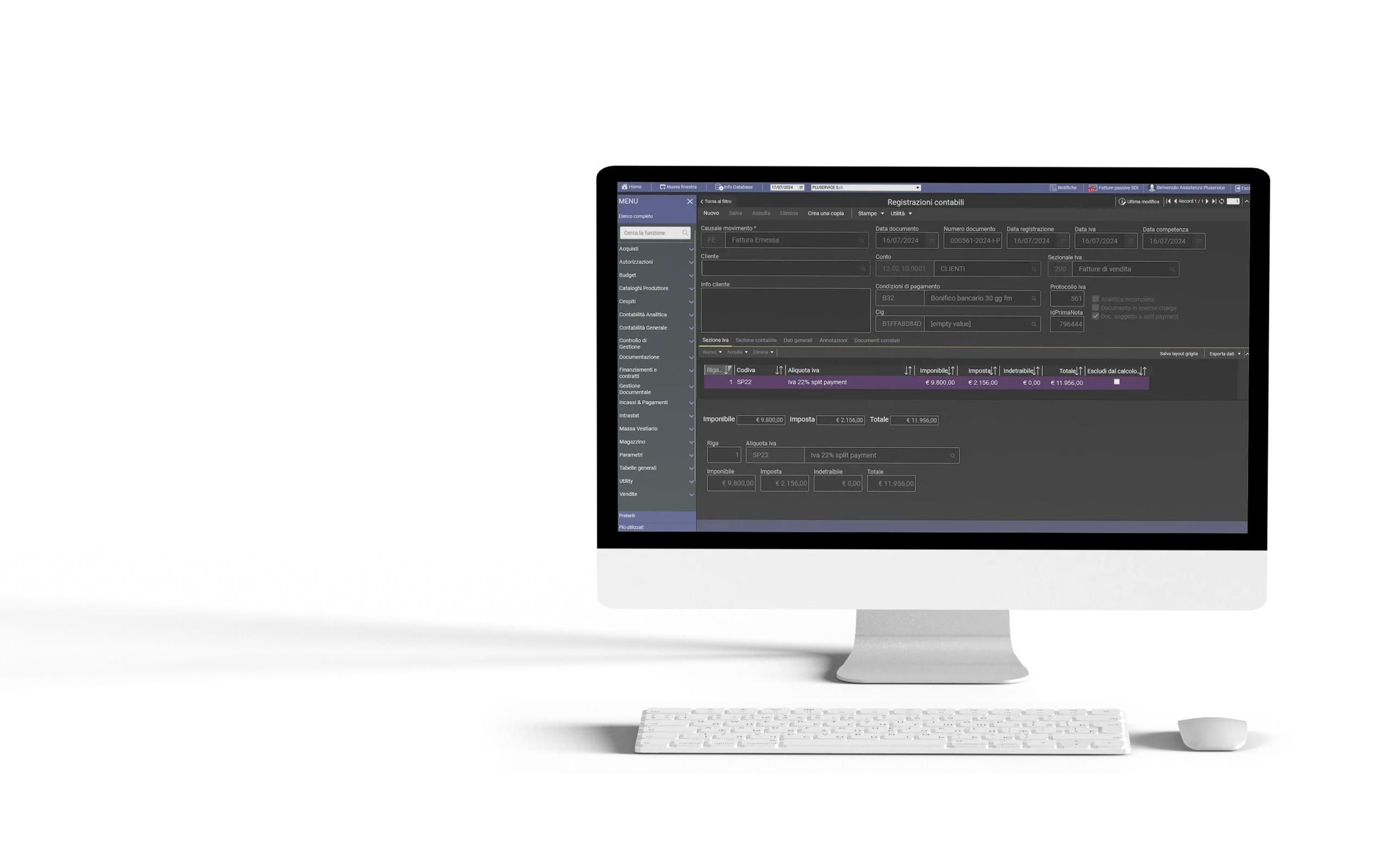
The Accounting module of Giove, Pluservice’s administrative ERP, was created precisely for this purpose:
to provide solid, integrated accounting management designed around the real needs of mobility companies.
Not just a recording system, but a tool that connects operations, accounting and control, ensuring data consistency and drastically reducing manual activities.


Contratti di servizio, modelli tariffari articolati, contributi pubblici, magazzini, cespiti, ammortamenti.
La contabilità nel settore del trasporto richiede precisione, continuità e una visione d’insieme.
Service contracts, complex fare models, public funding, warehouses, fixed assets and depreciation.
Accounting in the transport sector requires accuracy, continuity and a comprehensive view.
Giove is designed to manage this complexity in a structured way, integrating natively with Pluservice’s operational systems and ensuring:
The module covers the entire accounting scope of the company:
General accounting, with full management of journal entries, customers, suppliers and fixed assets.
Analytical and industrial accounting, for allocating costs to cost centres, projects and services.
Warehouse management, including inventory valuation.
Depreciation, with automatic calculation and continuous asset updates.
Every piece of data is consistent, traceable and immediately available for analysis and control.
Accounting does not stop at daily transactions.
Giove provides structured support for all closing and periodic reporting activities.
The system allows companies to produce monthly, quarterly, half-yearly and annual reports, with the automatic generation of adjustment entries, including:
A concrete tool to reduce time, errors and operational workload during the most critical phases of the accounting cycle.
All accounting information is immediately available for:
economic and financial analysis, financial statements and reporting, management control, integration with Business Intelligence tools.
The result is accounting that does not arrive at the end of the process, but becomes an active part of strategic decision-making.